NEWS
I did not allocate 2,000 hectares to my son in Abuja – Min Wike


The Minister of the Federal Capital Territory, Nyesom Wike, has denied claims circulating online that he allocated over 2,000 hectares of land in Maitama and Asokoro districts to one of his sons.
An online report had claimed that FCT Minister, Nyesom Wike, secretly allocated 2,082 hectares of land in Asokoro and Maitama, two of Abuja’s most exclusive districts, to his son.
The publication cited a Right of Occupancy allegedly issued in the name of JOAQ Farms and Estate Limited, which it linked to Wike’s family. The report insinuated that the land, officially meant for agricultural purposes, was being used as a front for personal gain.
Reacting to the reports, the Senior Special Assistant to the Minister on Public Communications and Social Media, Lere Olayinka, described the publication as “another falsehood from the vault of those whose main job is to malign the FCT Minister.”
In a press statement issued on Thursday, Olayinka said, “Not even a single plot of land has been allocated to any of the Minister’s children.”
He dismissed the allegations as the handiwork of “quack journalists, who lacked basic training in journalism,” questioning the logic behind the story.
“In Asokoro and Maitama of today, where can the FCT Minister see 2,082 hectares of land to allocate to anyone? Only quack journalists will go to town with story of allocation of 2,082 hectares of land in Asokoro and Maitama, reason some of us have continually advocated for professionalism in journalism,” the statement read.
Olayinka accused the publisher of attempting to defame the FCT Minister, adding that Wike and his family were within their rights to own lands anywhere in the FCT, provided they met all necessary conditions.
“My attention has been drawn to yet, another malicious falsehood coming from the same elements whose job is to defame and malign the FCT Minister, Nyesom Wike.
“Even though it is the right of the Minister and members of his family, both immediate and extended, to own lands anywhere in Nigeria, including the FCT, provided all necessary conditions are met, no land has been allocated to any of his children.”
“In the publication, a Right of Occupancy (R-of-O) issued to JOAQ Farms and Estate Limited, for Agricultural purpose was the only evidence used to justify the claim. For the avoidance of doubt, JOAQ Farms and Estate Limited, a company duly registered in Nigeria, got land allocation in Bwari Area Council for the purpose of farming. So what’s is wrong with a farmer getting land allocation strictly for the purpose of agriculture?” he queried.
Olayinka dismissed the entire report, stating that the publication was “false and should be disregarded.”
The Nigeria Labour Congress and the Trade Union Congress have warned of possible nationwide industrial action following unsuccessful talks with the Federal Government over workers’ demands.
The unions said their next steps would depend on the outcome of another meeting scheduled for Tuesday, October 27, adding that their affiliates and state councils had been directed to prepare for possible action if the government failed to make meaningful progress.
The meeting, held at the Federal Ministry of Labour in Abuja on Thursday, addressed demands for a reduction in petrol prices to 2024 levels, renegotiation of the national minimum wage, implementation of agreed tax relief measures and resolution of outstanding disputes involving health workers and other public servants.
In a joint statement signed by the NLC General Secretary, Benson Upah, and the TUC Secretary-General, Nuhu Toro, organised labour said the government delegation lacked the mandate required to negotiate substantively on the issues.
“No concrete commitments were secured, and the outstanding issues remain unresolved,” the unions said, expressing disappointment with the outcome of the meeting.
According to the statement, the Minister of Labour requested an adjournment until October 27 to allow the government to prepare adequately and ensure that relevant ministers and heads of departments and agencies attended the next session.
The unions said they remained open to dialogue but would not accept prolonged delays in addressing workers’ concerns.
“We will report back to our organs, and if no meaningful progress is made on Tuesday, the relevant organs of the NLC will decide the next line of action,” the statement added.
Labour also urged its affiliates, state councils and civil society allies to remain vigilant and begin preparations for possible nationwide action pending the outcome of the next meeting.
The unions, however, appealed to workers and members of the public to remain calm, expressing hope that the government would address their concerns at the rescheduled talks.
The dispute comes amid continuing concerns over rising living costs, fuel prices, workers’ purchasing power and the implementation of wage-related agreements following recent economic reforms.
Nigeria’s minimum wage was increased from ₦30,000 to ₦70,000 under the National Minimum Wage Act, 2024, following negotiations involving the Federal Government, organised labour and other stakeholders.
The unions’ renewed call for wage renegotiation reflects their demand for further discussions on pay and the economic pressures facing workers.
Organised labour is also seeking the implementation of agreed tax relief measures and the resolution of outstanding disputes involving the Joint Health Sector Unions and the Joint Public Service Negotiating Council.
The issues raised by the JPSNC include peculiar allowances, wage awards and hazard allowances, while the JOHESU dispute concerns outstanding terms of settlement affecting health-sector workers.
The NLC and TUC said they would attend the next meeting in the hope of securing progress, with any decision on industrial action to be taken by their respective organs if the talks fail to produce meaningful results.
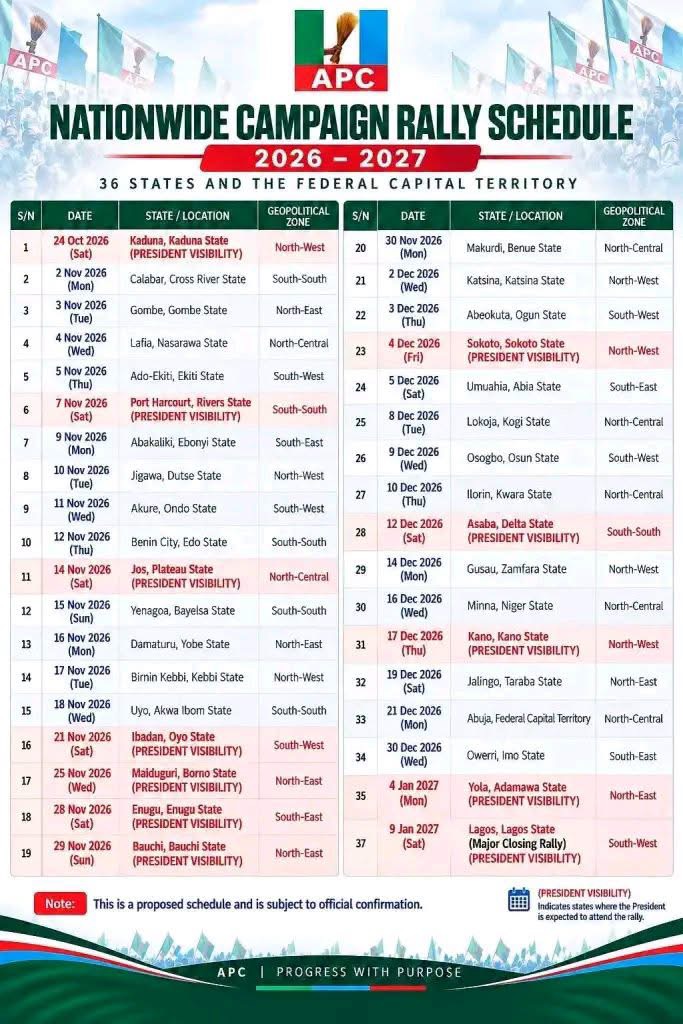
The All Progressives Congress (APC) has released a proposed nationwide campaign rally schedule covering all 36 states and the Federal Capital Territory ahead of the 2027 general elections, but Abia State is notably absent from the list of locations where President Bola Tinubu is expected to make personal appearances.
The campaign is billed to begin in Kaduna on October 24, 2026, and end with a grand rally in Lagos on January 9, 2027. While rallies are planned across the country’s six geopolitical zones, the party has identified only 12 strategic locations for the president’s direct participation.
The 12 proposed venues and dates are:
1. Kaduna, Kaduna State — October 24, 2026 (Saturday)
2. Port Harcourt, Rivers State — November 7, 2026 (Saturday)
3. Jos, Plateau State — November 14, 2026 (Saturday)
4. Ibadan, Oyo State — November 21, 2026 (Saturday)
5. Maiduguri, Borno State — November 25, 2026 (Wednesday)
6. Enugu, Enugu State — November 28, 2026 (Saturday)
7. Bauchi, Bauchi State — November 29, 2026 (Sunday)
8. Sokoto, Sokoto State — December 4, 2026 (Friday)
9. Asaba, Delta State — December 12, 2026 (Saturday)
10. Kano, Kano State — December 17, 2026 (Thursday)
11. Yola, Adamawa State — January 4, 2027 (Monday)
12. Lagos, Lagos State — January 9, 2027 (Saturday)
In the South-East, only Enugu made the list, leaving Abia, Anambra, Ebonyi and Imo without a scheduled presidential appearance under the current proposal.
NEWS
Jehovah’s Witnesses Ease Blood Rules: Members Now Free to Accept or Donate Blood Components on Conscience
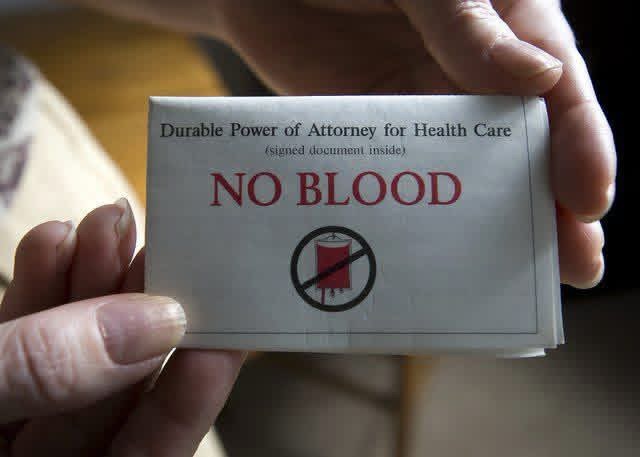
The Governing Body of Jehovah’s Witnesses has announced that members may now decide for themselves whether to accept or donate the four main components of blood, based on personal conscience.
In a statement released Friday by the organisation’s World Headquarters in Warwick, New York, and published on its website, the group said: “The decision to accept red cells, white cells, plasma or platelets from another person’s blood is a matter of personal conscience.”
It further stated that “each Witness must decide whether or not to donate blood for the clearly expressed purpose of providing components or fractions for use by another person.”
The long-standing ban on whole-blood transfusions remains firmly in place. “The long-standing refusal of whole-blood transfusions on religious grounds, a core teaching based on the command to ‘abstain from blood’ (Acts 15:20), is unchanged,” the statement emphasised.
Paul Gillies, international spokesman at the World Headquarters, said: “Blood remains sacred to Jehovah’s Witnesses, who continue to regard life and blood as precious gifts from God. We recognise that medical decisions involving blood components are a matter of conscience between each Witness and their God, Jehovah.”
The organisation described the change as a logical extension of earlier adjustments on blood fractions and the use of a person’s own blood during medical procedures. “Since the Bible does not comment on such decisions, they are a matter of individual conscience. That same reasoning has now been extended to the four main components of blood.”
Jehovah’s Witnesses stress that they value life and seek the best medical care available. They do not practise faith healing and work with doctors who can deliver effective treatment consistent with their beliefs. Local congregations will not interfere in these personal choices. “Congregations do not involve themselves in personal decisions that rest with the individual conscience. We will continue to respect and support the personal decisions of our fellow believers,” Gillies said.
The group, which claims more than nine million members in congregations across more than 200 lands, noted it is grateful for physicians who provide quality care while respecting members’ wishes regarding blood.
This latest clarification follows a March announcement that allowed individual Witnesses to decide whether their own blood could be removed, stored and returned during surgery or other medical procedures, while maintaining the prohibition on receiving blood from another person.
-
 OPINION1 year ago
10 seconds with Wike, reshaped my mindset on the difference between wants and needs – Udensi Bernard
-
 NEWS1 year ago
EFCC Detains Former Governor Tambuwal Over Alleged ₦189bn Fraud
-
 NEWS1 year ago
Gov. Mbah Increases Corps Members’ Allowance to ₦20,000
-
 NEWS1 year ago
Rep. Unyime Idem Unveils ₦1bn Family Business Grant for Constituents
-
 NEWS1 year ago
Appeal Court Orders FRSC to Pay ₦10 Million in Landmark Human Rights Case
-
 POLITICS1 year ago
Dr. Okezie Ikpeazu: A Voice That Still Inspires – Enyinnaya Appolos
-
 NEWS1 year ago
Ikonne to Otti: Fear God, Show Us 51 Schools for ₦54bn, Stop Forcing ₦36k Revenue on Aba Traders
-
NEWS1 year ago
Prince Paul Ikonne Applauds Governor Uzodinma’s Support for Aba State, Criticizes Governor Otti’s Stance